For global buyers, kitchen tools should do more than look attractive or fill a product catalog. They should feel natural during real use. A peeler rests against the palm. A saucepan handle stays steady near heat. A can opener should not demand painful wrist twisting. This is why is ergonomics important in kitchen tools: thoughtful design can reduce unnecessary strain, improve control, and support safer, more comfortable cooking.
Dr. Alan Hedge, a respected ergonomics researcher and former Cornell University professor, described ergonomics as “the science of fitting the task to the person.” That idea matters across international markets. Users have different hand sizes, grip strengths, cooking habits, and physical abilities. A narrow handle may suit one customer but press painfully into another user’s fingers. A heavy utensil may feel durable, yet become tiring after ten minutes of stirring. Small details matter.
Good selection requires more than checking appearance and price. Buyers should examine handle diameter, balance, surface texture, weight, and cleaning convenience. Silicone grips may help with control, but their long-term durability deserves careful review. Stainless steel can feel robust, though it may become slippery with wet hands. These choices are not always perfect. Some product claims also sound stronger than real user experience. Practical testing helps expose that gap. Ask users to chop, pour, open, and wash the tool repeatedly. Watch their wrists and shoulders. Listen to hesitation. A genuinely ergonomic kitchen tool should support confident movement, not require the user to adapt painfully.
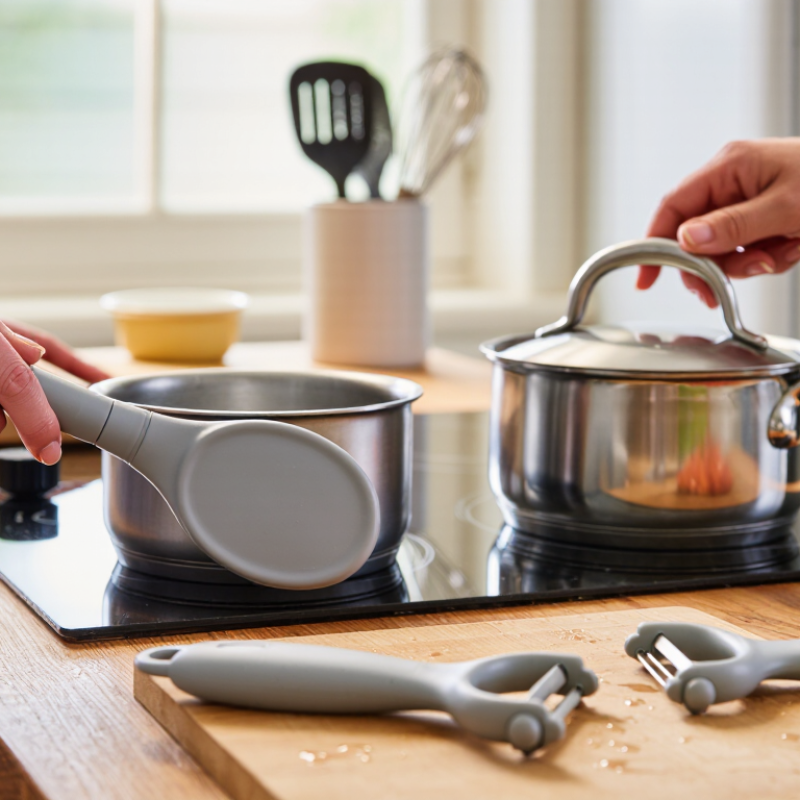
Ergonomics in kitchen tool design begins with the hand, not the catalog. A useful tool should fit different palm sizes, grip strengths, and cooking habits. Designers study wrist angle, finger pressure, reach, and repeated movement. A handle that feels comfortable for one person may cause strain for another. Small details matter. Rounded edges reduce pressure points. Textured surfaces improve control when hands are wet. Balanced weight can prevent excessive wrist bending. Yet comfort is not a universal measurement. User trials are essential.
When selecting tools for international markets, buyers should examine the whole use scenario. Is the tool used beside a low counter, a deep sink, or a compact stove? Does its handle remain stable with oil, water, or flour? A broad, soft grip may help users with limited hand strength. However, oversized handles can tire smaller hands. Adjustable or ambidextrous designs often serve more households. Materials should tolerate local humidity and regular washing. Clear care instructions support safe, consistent use. Product claims should follow documented testing, not attractive wording.
Quick showroom testing can be misleading. Ten seconds of comfort proves little. A better review includes chopping, stirring, lifting, and cleaning over several minutes. Observe red marks, awkward wrist angles, and slipping. Ask users to explain where control is lost. Their comments may challenge the original design brief. No test covers every body or kitchen. That limitation should be recorded honestly. Ergonomic quality improves when buyers compare measured performance with lived experience, then revise their assumptions.
| Tool Category | Primary Ergonomic Risk | Recommended Handle Diameter | Useful Handle Length | Preferred Grip Feature | Weight Guidance | Suitable User Considerations | Selection Priority |
|---|---|---|---|---|---|---|---|
| Chef's knife | Wrist deviation, pinch force, and repetitive cutting load | Approximately 25–35 mm at the main grip area | 100–130 mm for a secure full-hand grip | Contoured, slip-resistant surface with a comfortable finger clearance | Balanced toward the hand; avoid unnecessarily heavy designs | Users with smaller hands may prefer a slimmer handle and lighter blade | Very high |
| Vegetable peeler | High thumb pressure and repeated wrist movement | Approximately 30–40 mm for a power grip | 90–115 mm | Rounded body with a soft, non-slip surface and no sharp edges | Lightweight; excessive mass increases repetitive fatigue | Useful for users with reduced thumb strength or hand sensitivity | Very high |
| Can opener | High turning torque and awkward wrist posture | Approximately 30–45 mm | 100–140 mm | Large rotating knob, broad handles, and a textured grip | Moderate weight is acceptable if it improves stability | Prioritize low-torque operation for older adults and users with arthritis | Very high |
| Kitchen tongs | Repeated hand squeezing and spring resistance | Approximately 20–30 mm per handle | 180–300 mm, depending on heat exposure | Rounded handles with low-to-moderate spring resistance | Light enough for one-handed use; longer versions may weigh more | Choose lower actuation force for limited grip strength | High |
| Spatula and turner | Wrist extension and pressure against cookware | Approximately 25–35 mm | 100–140 mm | Slightly angled handle with a stable, non-slip surface | Balanced construction; avoid a heavy head or handle | Angled designs can reduce wrist bending during pan work | High |
| Kitchen scissors | Finger pressure, small-loop pinch, and repeated opening motion | Finger loops with approximately 25–35 mm internal clearance | 90–130 mm handle area | Rounded, spacious loops with smooth edges | Light to moderate weight with a smooth opening action | Larger loops are generally easier for users with stiff fingers | High |
| Garlic press | High closing force and concentrated palm pressure | Approximately 30–45 mm handle thickness | 100–150 mm lever length | Wide, rounded handles that distribute force across the palm | Moderate weight; leverage is more important than minimum weight | Select a high-leverage design for users with weak grip or joint pain | Very high |
| Measuring cup and spoon | Small handles, unstable grip, and visual reading difficulty | Approximately 15–25 mm handle thickness | 80–130 mm | Wide, readable handles with high-contrast measurement markings | Lightweight and easy to lift with one hand | Use clear metric and imperial markings for international markets | Medium |
| Peanut butter or jar opener | High twisting force and limited friction between hand and lid | Approximately 35–55 mm contact width | Not applicable; prioritize opening surface area | High-friction rubberized contact surface | Lightweight, but large enough to remain stable | Particularly useful for users with low hand strength or wet hands | Very high |
Stainless steel resists stains and usually feels durable. Reinforced nylon keeps daily tools lighter. Silicone can improve control near hot cookware. Poor silicone may absorb odors. Small cracks matter.
Hold the tool with three fingers and a relaxed thumb. Rounded handles can reduce palm pressure during chopping. Oval handles may prevent twisting with wet hands. If your wrist bends sharply, reconsider the design.
Tools weighing 80 to 180 grams often feel manageable. Preferences still vary between users. Hold a sample over a bowl for one minute. That test can reveal awkward balance quickly.
Check non-slip handles, rounded edges, and heat-resistant surfaces. Test the grip with dry and damp hands. A wet hand should not slide toward heat or sharp edges. Vague quality claims are not enough.
Inspect joints, hinges, coatings, and handle connections. Choose designs with fewer narrow gaps. Food can hide inside those spaces. Verify dishwasher suitability instead of assuming it. Repeated heat may reduce flexibility or damage finishes.
Handles should fit different hand sizes and require limited squeezing force. Left-handed and right-handed use should feel natural. High-contrast markings may assist users with reduced vision. Accessibility is easy to overlook.
Request samples, material specifications, inspection records, and batch traceability. Review food-contact documents and heat-resistance results. Supplier explanations should include tolerance limits and corrective actions. A polished catalogue proves little.
Test samples with different hand strengths and realistic kitchen temperatures. Repeat tasks can reveal fatigue after several minutes. Keep independent samples from production batches when possible. I sometimes judge appearance too early. Ergonomics needs another look.
Choosing ergonomic kitchen tools begins with understanding how design affects comfort, control, and efficiency. The question “why is ergonomics important in kitchen tools” can be answered by considering reduced hand strain, improved grip stability, and safer performance during repeated tasks. Global buyers should assess the intended users’ hand sizes, strength, mobility, and cooking habits, while matching each tool to tasks such as cutting, stirring, lifting, or peeling. Handle shape, surface texture, material, balance, and overall weight should work together without creating unnecessary pressure or fatigue.
A reliable selection process should also examine safety, durability, cleaning convenience, and accessibility for different users. Buyers should review product quality consistently and confirm that manufacturing practices support dependable performance across markets. Cultural preferences, common cooking methods, storage habits, and regional expectations may influence tool size, design, and materials. By combining user-centered design with careful supplier evaluation and awareness of applicable global requirements, buyers can choose kitchen tools that are practical, comfortable, inclusive, and suitable for long-term everyday use.

 DRS Boards