Choosing China’s best food preparation equipment for precision requires more than comparing prices or polished product photographs. It demands practical testing, technical knowledge, and careful attention to repeatable results. In professional kitchens, a one-gram weighing error can change a sauce, dough, or seasoning balance. A blade that heats ingredients can also affect texture and color.
Nathan Myhrvold, founder of Modernist Cuisine, said, “Cooking is an art, but all art requires knowing something about the techniques and materials.” His observation supports a central question: how to improve precision in food preparation through better equipment and better working methods. Digital scales, programmable cutters, temperature-controlled mixers, and uniform slicing machines can reduce variation. However, equipment cannot replace trained judgment. Operators still need to check calibration, ingredient temperature, cutting speed, and cleaning procedures.
Real experience often reveals uncomfortable details. A machine may perform perfectly during a supplier demonstration, yet struggle with sticky dough in a busy kitchen. A powerful processor may leave small uneven pieces around the bowl. These weaknesses matter. They should be recorded, tested, and discussed openly. No product is flawless.
This guide examines Chinese food preparation equipment through accuracy, durability, usability, maintenance, and after-sales support. It also considers measurable details, such as portion consistency, temperature stability, processing time, and material quality. The goal is not to praise every manufacturer. It is to identify equipment that helps kitchens produce reliable results under real working conditions. Precision begins with honest testing.
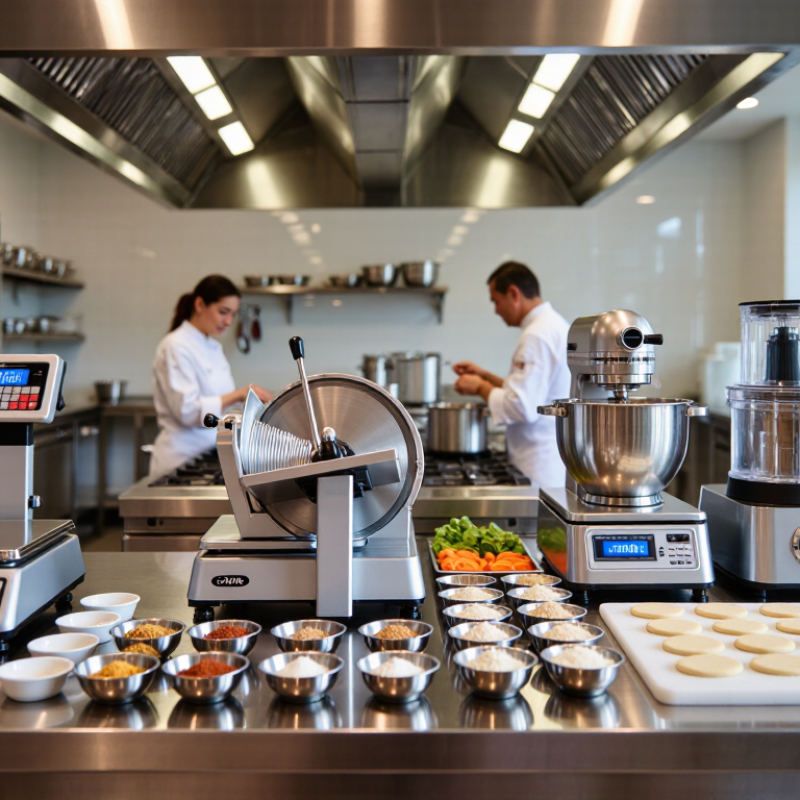
Precision food preparation equipment made in China covers several distinct tasks. Digital portioning scales help kitchens divide dough, meat, or vegetables into repeatable weights. Compact slicers and dicing machines produce consistent pieces for salads, fillings, and ready-to-cook meals. The cut matters. Uneven cubes can cook at different speeds.
For higher-volume work, programmable cutters and mixers let operators set speed, time, and batch size. Temperature-controlled mixing bowls are useful for delicate preparations, while vacuum tumblers help distribute marinades through meat. A clear control panel is practical when staff change between recipes. Still, a digital display alone does not prove accuracy; check repeatability with real ingredients and routine calibration.
Chinese manufacturers offer equipment across entry-level and industrial capacities, but specifications can vary considerably. Ask for cutting tolerances, scale accuracy, food-contact material details, and cleaning instructions before comparing models. Inspect sample cuts, not just product photos. Service access matters, too: blades, seals, and sensors eventually need replacement. Some machines look precise on paper yet require frequent adjustment on a busy line. That is a detail worth testing before purchase.
| Equipment Type | Precision Function | Typical Applications | Key Parameters to Specify | Practical Verification |
|---|---|---|---|---|
| Digital food scales | Measures ingredient or portion weight; available resolution and capacity vary by model. | Ingredient batching, recipe formulation, portion control, and packaging checks. | Capacity, display increment, weighing platform size, tare function, and calibration method. | Check the scale with suitable certified test weights across the working range; confirm repeatability and calibration records. |
| Programmable portioning machines | Dispenses or portions product to a set target by weight, volume, or machine cycle. | Prepared foods, fillings, sauces, dough portions, and other products requiring consistent serving sizes. | Product type, target portion range, dosing method, changeover needs, and permitted portion variation. | Run representative product at normal operating speed, then compare a sample of portions with the agreed target and tolerance. |
| Precision liquid fillers | Controls fill quantity using a selected volumetric, piston, flow-based, or weight-based system. | Sauces, dressings, oils, beverages, and other pumpable food products. | Fill range, product viscosity, container format, nozzle design, temperature, and cleaning requirements. | Test with the actual product and container; weigh or measure repeated fills and check for drips, foam, and product loss. |
| Adjustable slicers and dicers | Sets slice thickness or cut dimensions through blade, spacing, or tooling adjustments. | Vegetables, fruit, cheese, cooked meat, and other foods suited to the machine’s design. | Cut-size range, product dimensions, blade configuration, feed method, and required cut consistency. | Inspect samples from a sustained production run, including pieces from different positions in the feed stream. |
| Programmable food cutters and choppers | Controls processing through selectable speed, time, or operating cycles; particle size also depends on the product and load. | Minced vegetables, herbs, meat preparations, pastes, and blended food components. | Batch capacity, blade type, speed settings, cycle control, product temperature, and desired texture. | Compare particle-size distribution and texture using a standard recipe, batch size, and operating procedure. |
| Temperature-controlled cooking kettles | Monitors and regulates product temperature; heating performance depends on the kettle design and load. | Sauces, soups, fillings, jams, and other foods prepared with controlled heating or mixing. | Working volume, temperature range, sensor location, heating method, agitation, and control-system features. | Compare the machine’s displayed temperature with a calibrated reference at representative points in the product. |
| Programmable planetary mixers | Provides selectable mixing speeds and timed cycles; mixing results vary with tool, batch size, and formulation. | Creams, batters, doughs, fillings, and other products suited to planetary mixing. | Bowl capacity, speed range, available attachments, timer, batch-size limits, and cleaning access. | Check speed and timer operation, then assess mixing uniformity using a consistent formulation and batch size. |
| Dough sheeters | Adjusts roller gap to produce dough sheets of a specified thickness; actual results depend on dough properties and setup. | Pastry, laminated dough, noodles, and other sheeted dough products. | Roller-gap range, sheet width, adjustment increments, conveyor arrangement, and dough type. | Measure sheet thickness at multiple locations and repeat the test after normal machine adjustment. |
| Vacuum mixers and tumblers | Controls operating time and, where fitted, vacuum level to support mixing, tumbling, or product treatment. | Marinades, meat preparations, and other compatible products requiring controlled mixing or tumbling. | Usable batch capacity, vacuum range, cycle settings, mixing action, product limits, and cleanability. | Verify vacuum readings and cycle settings; evaluate product uniformity using the intended recipe and loading procedure. |
Selection note: Equipment capabilities and tolerances differ by model and application. Confirm specifications with the supplier and validate performance using the actual ingredients, batch size, operating conditions, and acceptance criteria.
Scales portion ingredients by weight, while slicers and dicing machines create consistent pieces. Mixers and cutters can process larger batches.
Even pieces cook at similar speeds and create a more uniform texture. Uneven vegetable cubes may soften at different rates.
No. Test repeatability with real ingredients, and calibrate scales and sensors regularly. A display can look convincing.
Try a small batch and check cut consistency, bruising, feed control, and blade removal. Product photos reveal little.
Match bowl size and mixing action to your usual batch. An oversized bowl may leave sauce or dough unevenly blended.
Ask for temperature-uniformity data. Check several points with probes, not only the area near the control sensor.
Secure fittings, aligned blades, and low vibration help. Ingredients still vary, so perfect uniformity is not always realistic.
Accessible joints and removable parts make inspection and cleaning easier. A fast machine can still disrupt a shift if cleaning takes too long.
Request cutting tolerances, scale accuracy, food-contact material details, cleaning instructions, and information about replacement parts and service access.
Yes. Check it with your own ingredients and confirm that power, water, and maintenance needs fit the site. Small practical issues matter.
China offers a wide range of food preparation equipment designed to support accurate, consistent processing, from cutting and mixing machines to portioning and forming tools. Precision depends on more than the machine itself: adjustable settings, stable operation, repeatable results, and controls suited to the task all matter. When choosing equipment, consider the food type, required output, desired cut or texture, production volume, and how easily settings can be changed between tasks. These factors help match equipment capabilities to practical processing needs.
Materials and manufacturing quality also affect hygiene, durability, and performance. Food-contact surfaces should be easy to clean and resistant to wear, while safety features should protect operators during routine use. To understand how to improve precision in food preparation, establish a consistent operating procedure, inspect equipment regularly, and calibrate controls when needed. Tracking results such as portion size, processing time, and product consistency can reveal when adjustments or maintenance are necessary and help keep performance reliable over time.

 DRS Boards